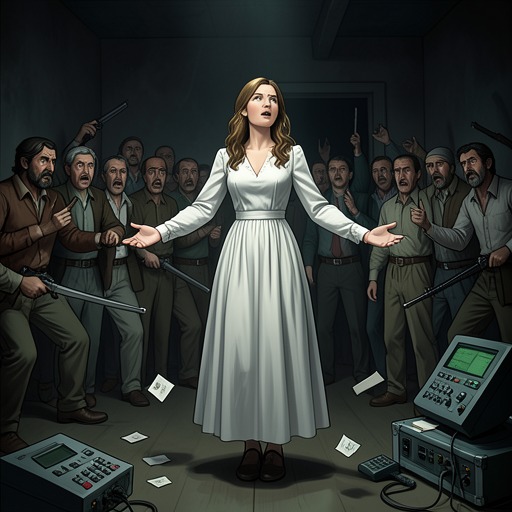
The destruction of Chamberlain
Stephen King Three Classic Novels Box Set: Carrie, 'Salem's Lot, the ShiningThe destruction of Chamberlain is the town-wide catastrophe unleashed by Carrie White after the Spring Ball disaster, converting a concentrated act of revenge into a chain reaction of fire, explosion, infrastructure failure, and mass death. Its decisive significance lies in the way supernatural force becomes civic breakdown: Carrie does not merely destroy a room or punish a group of tormentors, but moves through Chamberlain by disabling the ordinary systems that should contain disaster, leaving the town to burn while its institutions struggle to understand what is happening.
Causes and Immediate Trigger
The catastrophe grows out of the violence directed at Carrie White at Ewen Consolidated High School. The humiliation was not an abstract slight: Thomas Everett Ross and Carrie were drenched in pig blood during the Spring Ball, after Carrie had already been ostracized and abused by classmates. Earlier testimony records that Carrie was attacked during her first menstrual period, with sanitary napkins thrown at her while she believed she was bleeding to death. The event therefore carries forward a history of physical and verbal abuse rather than appearing as an isolated supernatural eruption.
The first visible disaster begins inside the school. The sprinklers activate across the gym, sending water onto the basketball court and into the electrical equipment. Josie Vreck, holding a microphone stand, is unable to let go; electricity passes through him, smoke rises from his shirt, and he falls onto an amplifier that collapses into the water. The resulting fire spreads from the equipment to the stage mural and then through the backstage collection of uniforms, books, and papers. The school auditorium and gymnasium, designed as a shared public space, become the first failed node in a larger network of destruction.
The emergency response is compromised before it can begin. A contemporary report states that the hydrants serving the area have been vandalized, while water pressure from the city mains between Spring Street and Grass Plaza is inadequate. The apparent rain inside the gym is therefore no rescue: the sprinkler system worsens the electrical danger, while the town's external firefighting capacity has already been deprived of the water it needs. The result is a fatal reversal in which a safety system becomes an instrument of death and the infrastructure intended to protect the town becomes part of its vulnerability.
Carrie's Route Through the Town
After leaving the school, Carrie White moves through Chamberlain in a state of physical collapse and emotional extremity. Her route is not presented as random destruction. She opens the hydrant at Grass Plaza after wrenching loose its heavy side and top lug nuts, forcing water outward in a white, cruciform pattern. She then proceeds toward Teddy's Amoco, opening the first gas station she reaches and continuing beyond it. The movement gives the catastrophe a directional form: the town becomes a sequence of vulnerable points encountered by a wounded person who has decided that others must share her ruin.
Witness testimony gives the supernatural action an unsettlingly practical texture. Thomas K. Quillan reports seeing a hydrant's large lug nuts unscrew themselves before the hydrant blew. He also describes Carrie as apparently pleased by the result, interpreting the released water as a shower for those inside the school. The testimony is uncertain and fragmented, but its central fact is clear: hydrants are not simply failing; their mechanisms are being forcibly operated. The destruction thus links Carrie's telekinesis to municipal hardware, turning small metal fittings into triggers for a town-wide emergency.
The danger spreads through electrical lines as well. Power transformers bloom with purple light, high-tension wires fall into the streets, and people who touch the cables are thrown into jerking electrical dances or left smoldering in the road. The fires are consequently not confined to the school or gas stations. They occupy streets, utilities, and homes, making movement itself dangerous. The town's geography becomes a map of exposure, with ordinary routes transformed into corridors of electrocution, flame, and panic.
Infrastructure Failure and Escalation
The first emergency call reaches Sheriff Otis Doyle through Officer Jacob Plessy at 10:21 p.m., but information does not produce control. At 11:15 p.m., Tony's Citgo on Summer Street explodes with a roar that illuminates Courthouse Park, the duck pond, and the Little League diamond in scarlet. A second explosion follows, scattering glass, wood, and pieces of the station. The blast makes the destruction legible as a civic event: this is not only a school tragedy but the burning of Doyle's entire town.
The rescue network is overwhelmed and then isolated. Motton and Westover are asked to send ambulances and hearses, while young people establish a hospital inside the police station. Yet water remains unavailable where it is most needed. Firefighters find that the hydrants cannot supply them, and the school eventually explodes after the new pumper arrives. The failure is not simply a shortage of courage or willingness. Firefighting equipment is present or on its way, but the systems that would make it effective have been vandalized, drained, or destroyed.
The damage continues after the news reports cease. At 12:06 a.m., a gas main on Jackson Avenue is opened; at 12:17, an ambulance attendant's discarded cigarette butt helps ignite the conditions for another explosion as the rescue vehicle speeds toward Summer Street. The blast destroys nearly half a block, including the offices of the Chamberlain Clarion. Seven minutes earlier, the telephone exchange had suffered a complete jam of every remaining operating line. The town is therefore cut off both physically and informationally: fire consumes the built environment while the communication system becomes unable to organize a response.
Scale of the Disaster
By 12:45 a.m. on May 28, the school has burned itself out, but downtown Chamberlain is still ablaze. City water has been tapped through much of the area, and only low-pressure supply from the Deighan Street mains saves some business buildings below Main and Oak streets. The fire at Tony's Citgo continues until nearly ten o'clock that morning because water exists on Summer Street without enough firefighters or equipment to use it. Assistance from Lewiston, Auburn, Lisbon, and Brunswick is already moving, but no outside equipment arrives until one o'clock, after the cascade has established its own momentum.
The worst destruction occurs on the West End below Brickyard Hill, where a gas-main explosion produces a fire that rages through most of the following day. Another electrical fire on Carlin Street, caused by downed power lines, eventually guts the north side of the street, including the bungalow where Margaret White gave birth to Carrie White. The disaster consequently reaches backward into the town's domestic and biographical landscape: even the house associated with Carrie's origin is consumed as part of the widening pattern.
The sequence can be read as a wandering loop with an almost certain destination: Carrie's home. Her path through Chamberlain is mapped by flash points, from the school to the hydrants, gas stations, electrical lines, and residential streets. That structure gives the disaster an arc of return. The town is not merely destroyed around Carrie; it is traversed by her, and the destruction progressively narrows toward the place where her life began.
Death Toll and Historical Memory
The national Associated Press ticker later records Chamberlain's death toll at 409, with 49 people still listed as missing. The number fixes the catastrophe at a scale far beyond the Spring Ball itself. A local event of bullying, coercion, and revenge becomes a mass-casualty disaster whose victims include students, bystanders, residents, rescuers, and people caught in infrastructure failures far from the gymnasium.
The destruction also changes the meaning of the town's physical survival. Later reporting describes residential streets on the East Side still standing beneath old oaks, with undamaged saltboxes and ranch-style houses on Morin Street and Brickyard Hill. Yet the intact pastoral surface lies beside a blackened and shattered center. Many houses carry FOR SALE signs, while occupied homes bear black wreaths on their doors. Chamberlain remains geographically present but socially wounded, a town living at the edge of its own ruins.
The event is therefore remembered not only as Carrie's destruction of Chamberlain but as the exposure of a community's accumulated failures. The humiliation that initiated the violence, the adults' earlier inability to protect Carrie, the compromised hydrants, the electrical and gas networks, the blocked telephone exchange, and the delayed emergency response all contribute to the final scale of loss. The town's disaster is supernatural in agency but systemic in consequence: one person's extraordinary power finds a human environment already capable of turning panic into catastrophe.